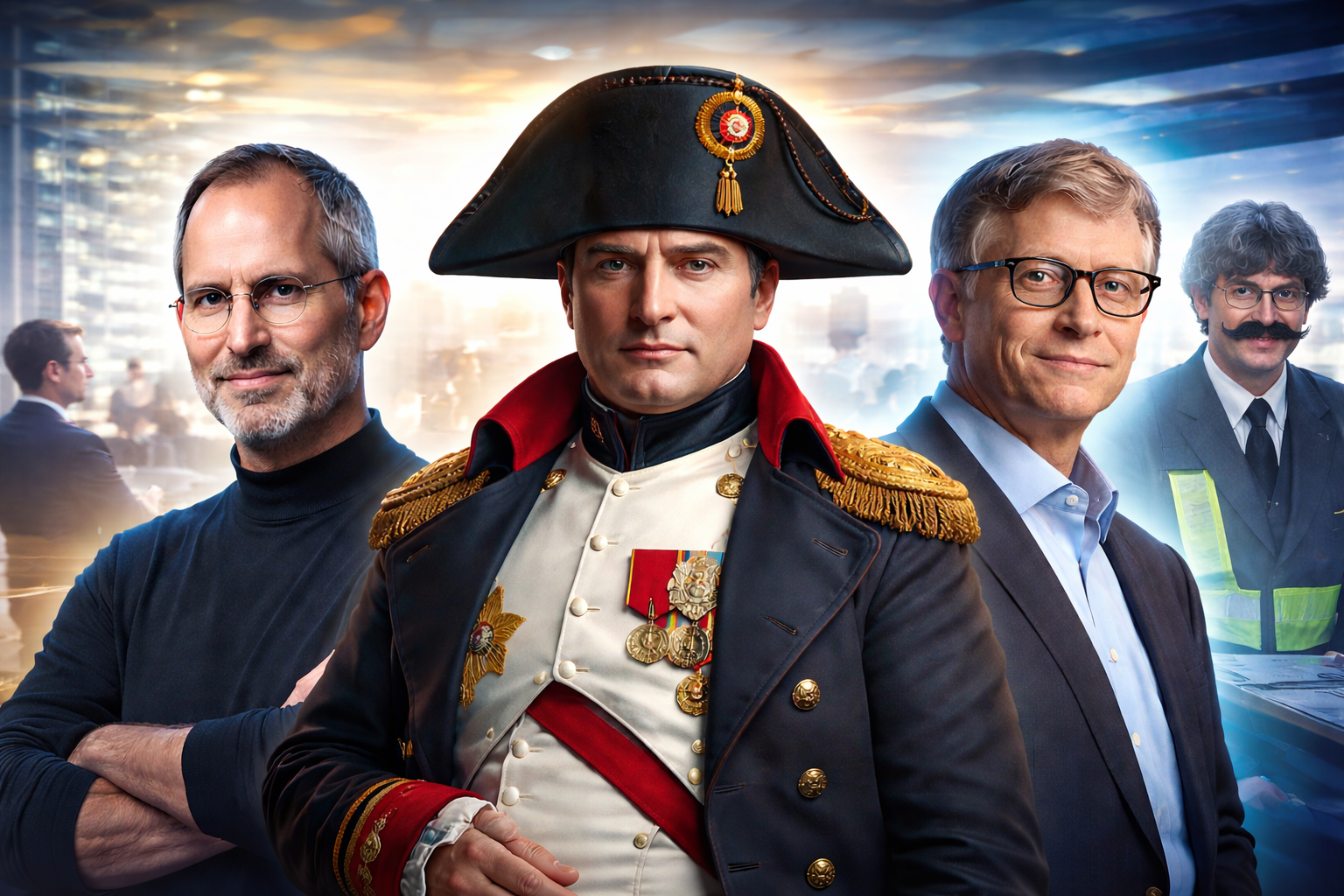
Napoleon, Leadership, and the Modern Age
Keeping soldiers in rank and keeping them alive are unique challenges to the military leader, who musters men to risk their lives in obedience to their commanders.
“The leader must keep his followers… and it is hard to exaggerate the difficulty of that task”
— Wills, 1995, p. 85
Wills employs the example of Napoleon’s military leadership as the model for understanding both effective strategy, while simultaneously warning of the dangers of overextending one’s own authority. In just two decades, Napoleon rose from a junior officer to the Emperor of the French and superseded all conventional military ranks, granting him supreme civil and military authority. While the unique conditions of the French Revolution and his own genius might seem unrepeatable, a careful study reveals that Napoleon offers a number of contemporary parallels for modern leadership domains.
Napoleon’s tactics can be translated, as Wills demonstrates using the work of the Prussian theorist Carl von Clausewitz, into general principles of leadership in the modern era. At the same time, Napoleon’s own missteps in his ascendency to power reveal how the needs of one’s followers remain a constraint on any governance, no matter the historical period.
“The French Revolution changed the whole world, for ever. It marks a watershed in human experience, but no one saw their world more changed than the Buonaparte”
— Broers, 2014, p. 94
Napoleon’s early life unfolded within this historical moment of dramatic upheaval and collapsing institutions. The Revolution dismantled the ancien régime and opened pathways for ambitious young officers to rise through merit rather than birth. This shift in priorities, tactics, and promotion from the old aristocratic guard to a new merit-based leadership culture is central to Napoleon’s success.
The Revolution also challenged the very nature of military command.
“Wars fought between the old powers of Europe were contained spasms within a structure of stability”
— Wills, 1995, p. 90
European kings did not seek to overturn monarchy in rival states, which could be expected to repay war debts and render political homage after defeat. By contrast, Napoleon’s forces were inspired to follow him for precisely that anti-imperial cause. Napoleon successfully translated the era’s political fanaticism into a following of “mercenary plunderers free from aristocratic control” (Wills, 1995, p. 91).
Just as the political winds were quickly changing, the tactics on the ground reflected Napoleon’s desire for progress. His troops were not afforded the luxury of holding fortified positions; instead, they were pressed to move quickly. This mobility was one of Napoleon’s methods for maintaining morale, since soldiers were promised that supplies and rewards lay just beyond the next enemy line.
“Morale… was sustained by new opportunities”
— Wills, 1995, p. 92
He carried these devoted troops across Europe to dominate more than 90% of the continent’s population, but perpetual conquest proved predictably unsustainable. The same restless expansion that secured his empire ultimately precipitated the collapse of his own devoted military constituency.
Imperial Drift and Leadership Decline
“Napoleon was not French,” according to many early nineteenth-century critics.
As Dwyer notes, his detractors quickly painted the fallen emperor as “a foreigner in habit, character and language,” driven by “unbounded ambition” (Dwyer, 2018, p. 34).
His position as an outsider to the French ruling class had helped propel him into the very elite he once resented, but his transformation into an imperial ruler exposed the realities of his own despotism.
As this political and civil identity became clearer, Napoleon faced real backlash, especially as Bourbon propaganda chipped away at the leadership persona he had projected for so long. How could the Emperor also be the liberator?
Napoleon’s rise depended heavily on his presence on the battlefield and on his habit of controlling decisions directly. As he took on more civil and administrative responsibilities, he had to delegate, and he often did so poorly. His attempt to oversee nearly every imperial matter strained his health and slowed military operations that had succeeded only because of their speed.
His absence was visible at Waterloo, when his personal control and decision-making could no longer be relied on. By 1815, Napoleon was no longer the direct, improvisational commander of the Italian campaigns, but an emperor whose subordinates behaved just like the old guard he once outflanked.
Grouchy “could hear the sounds of battle in the distance” yet “had not thought to rejoin his Emperor, but only to follow his orders to the letter.”
— Englund, 2004, p. 809
This was a revealing sign of how far his leadership had drifted.
Modern Parallels: From Emperors to CEOs
The rise and fall of Napoleon’s career offers a recognizable pattern for modern leadership. When he was close to the day-to-day work of his military operations, he won loyal followers who saw him in the saddle, reading the terrain, and pushing through enemy lines with speed. As he grew more imperial, his identity drifted away from the qualities that had once made him effective.
Many corporate executives fall into a similar pattern of disconnection. The founder who built the company from day one begins to lose touch with employees and customers as he runs the business through layers of delegated leadership from a glass office on the upper floors.
American reality television has even played off this motif in shows like Undercover Boss, where leaders rediscover the bottom-rung realities that once made them successful.
And just as Napoleon toppled established crowns with his “rag-tag” forces, large corporate empires like Microsoft and Yahoo have been overtaken by smaller, more flexible rivals such as Google and Apple. Both emperors and executives depend on loyalty and initiative among the ranks and cannot survive on title and accolades alone.
Proximity and adaptability are not just helpful at the beginning, but necessary at every stage of leadership. What earned a leader credibility in the first place cannot be replaced by ceremony or prestige.
How many companies could be fit into this Napoleonic paradigm?
Blockbuster vs. Netflix, Myspace vs. Facebook (Meta), Sears vs. Amazon.com, and so on.
“The failed general loses his followers literally—they die because of his mistakes.”
— Wills, 2005, p. 98
In business, the casualties are not soldiers, but companies, products, and workers who fade from the field when leaders stop paying attention to the battle in front of them.

Leave a Reply