The early Church did not rush people to the font. In the third century, the Apostolic Tradition describes catechumens hearing the Word for as long as three years before baptism, and those who brought them were questioned about how they lived, not only about what they believed. Becoming a Christian was a passage, and the Church marked each stage of it with prayer.
Protestant Christians have largely lost this. The Sarum Ordo ad faciendum catechumenum (the order for making a catechumen, said at the church door) survived in shortened form at the opening of the 1549 baptismal rite, and then quietly disappeared.
I present here two examples of Anglican bodies setting out to recover it.
The Church of South India, formed in 1947 and baptizing converts out of Hinduism and Islam, needed a rite that marked a public break with old allegiances. The Anglican Church in North America, catechizing adults in a post-Christian West, needed the same thing for a different reason.
Both rites are given in full below, followed by a short comparison and some counsel for clergy who want to use them.
1. The ACNA Rite
This rite appears as an appendix to To Be a Christian: An Anglican Catechism, prepared for the Anglican Church in North America under the editorship of the Rev. Dr. J. I. Packer. A printable PDF is included at the end of this section.
Appendix 2
A Rite for Admission of Catechumens
This form is to be used for adults, or older children who are able to answer for themselves, at the beginning of a course of instruction in the teachings of the Church. It is to be used in preparation for Holy Baptism or, if those seeking admission were baptized as infants, for Confirmation.
Greeting
On the day appointed, the persons to be received as Catechumens are brought by their sponsors to the church and remain by the principal door until the Gospel has been proclaimed.
The Celebrant greets them at the door.
Celebrant
What is your hope?
Catechumens
New life in Christ.
Celebrant
What do you desire of God and of this congregation?
Catechumens
That I may grow in faith, hope, and love.
Then the Celebrant says,
If you hope to enter into eternal life, you must, by his grace, follow in our Lord’s steps, for he said: “If anyone would come after me, let him deny himself and take up his cross and follow me.”
Examination
Then the Celebrant asks,
Will you turn to Jesus Christ and accept him as your Lord and Savior?
I will, with God’s help.
As none can do this without God’s grace, found in Word and Sacrament, will you join with us in our common life of worship, teaching, service, and fellowship?
I will.
Enrollment and Exorcism
The Celebrant leads them to the chancel steps, where they kneel, and the Celebrant prays over them, saying,
Let us pray.
O Lord God of hosts, before the terrors of whose presence the armies of Hell are put to flight: Deliver these your servants from the powers of the world, the flesh, and the Devil; cast out from them every evil and unclean spirit that lurks in the heart, and any spirit of error or wickedness; and make them ready to receive the fullness of the Holy Spirit; through Jesus Christ our Lord. Amen.
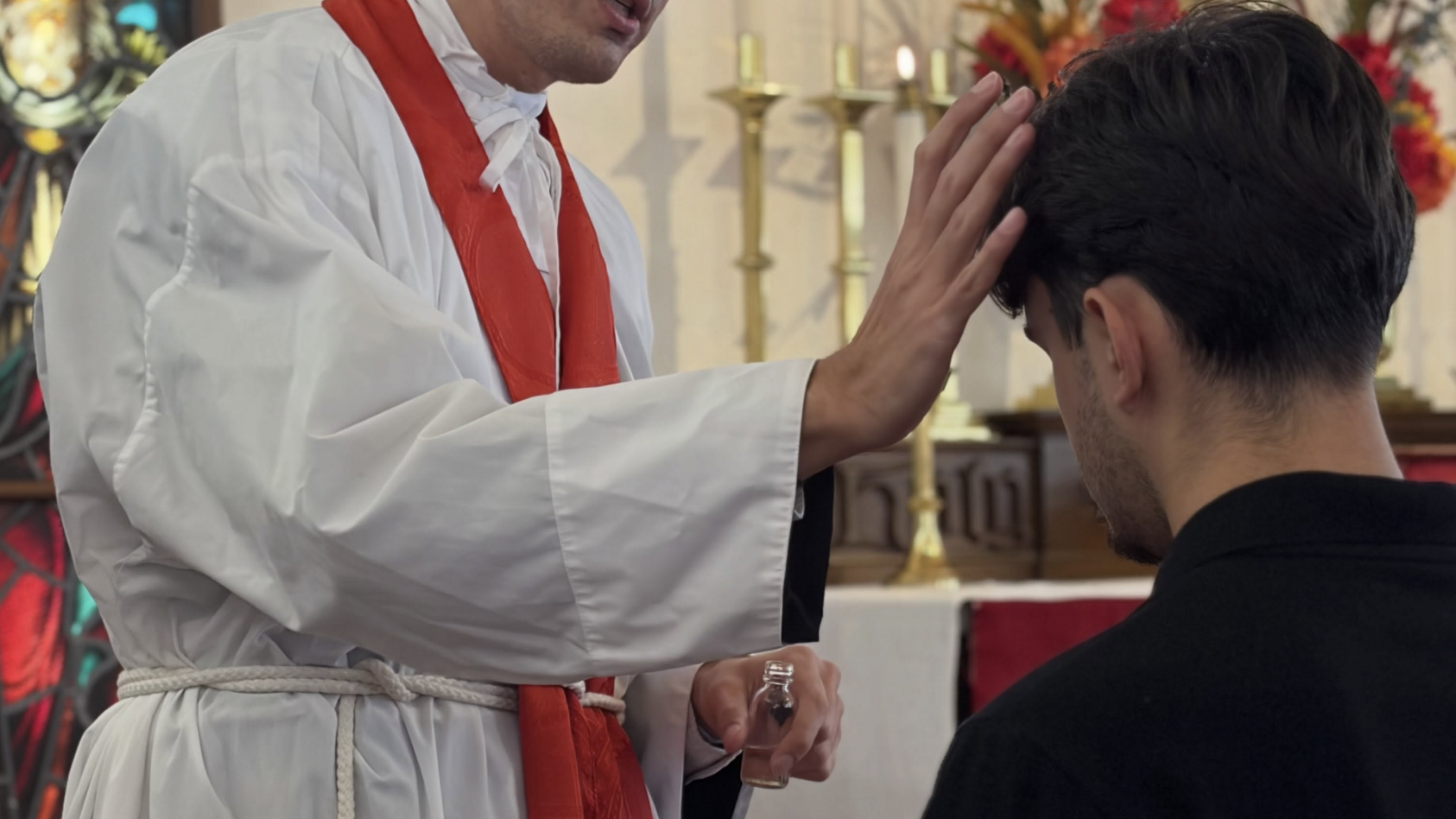
The Celebrant then makes the sign of the Cross upon the forehead of each one (and may use the Oil of Catechumens to do so), saying to each,
Almighty God deliver you from the powers of darkness and evil and lead you into the light and obedience of the kingdom of his Son, Jesus Christ, our Lord. Amen.
The Blessing
The Catechumens all kneeling, the Celebrant then blesses them, saying,
Almighty God, who in his love for you has called you to the knowledge of his grace, grant you an entrance into his kingdom; through Jesus Christ, our Lord. Amen.
Sponsors accompany Catechumens to seats among the people.
The service continues with the Sermon and Nicene Creed.
2. The Church of South India Rite
From The Book of Common Worship of the Church of South India (1963), where it stands as the first part of the order for “The Baptism of Persons Able to Answer for Themselves.” Its title deliberately echoes the old Sarum Ordo ad faciendum catechumenum.
The Baptism of Persons Able to Answer for Themselves
The Office for Making a Catechumen
The admission of a person as a catechumen should normally be at a service of public worship, and may take place after the Lessons. Suitable lessons may be read.
After the Lessons the candidate is led forward by his sponsors, and the presbyter says:
N, who is present here, desires to be received as a catechumen. He has promised to undergo regular instruction. Let us therefore pray for him and welcome him with brotherly love.
Let us pray
Almighty and most merciful God, we pray thee to look favourably upon this person who desires to be brought out of darkness into the clear light of thy truth and the glorious liberty of thy children. Grant that he may now make a sincere profession of his purpose, and may receive of thee grace to continue steadfast in the path he has chosen, through Jesus Christ our Lord. Amen.
He then asks: N, what do you desire?
Answer: I ask of you Christian teaching and Holy Baptism.
Do you accept Jesus Christ as Lord and Saviour?
Answer: I do.
Are you willing to place yourself under our guidance and instruction, that you may be prepared for admission into the Church by baptism?
Answer: I am willing.
Do you renounce all those customs and practices and teachings which you know to be contrary to Christ’s will?
Answer: I do.
Do you promise to be diligent in prayer, regular at public worship of the Church, faithful in receiving instruction and in witnessing to others?
Answer: I promise.
The people stand. The presbyter greets the candidate(s) according to the custom of the place, and says:
We receive you as a catechumen of the Church of Christ, in the name of the Father, and of the Son, and of the Holy Spirit. May almighty God, who has put these good desires into your heart, bring the same to good effect. Amen.
Let us pray
All kneel.
¶ Almighty God, the Father of our Lord Jesus Christ, look upon this thy servant, the catechumen; give him a new heart and renew within him a right spirit to know and to do thy will with a ready heart and willing soul. Make him worthy of the holy initiation of baptism, unite him to thy holy Church, and give him a share in thy divine mysteries, through Jesus Christ our Hope. Amen.
Or
¶ O Lord Jesus Christ, Good Shepherd, who didst lay down thy life for the sheep; mercifully receive this brother into thy fold. Join him with thine own flock, and lead him to the pleasant pastures of everlasting life; for thy mercy’s sake. Amen.
Or
¶ The minister may pray extempore.
Comparing the Two Rites
Set side by side, the two rites share a skeleton: a public setting within the Sunday liturgy, sponsors who present the candidate, a question about what the candidate desires, a confession of Christ as Lord, and prayer that God would finish what he has begun. But their emphases differ in ways worth noticing.
- Ceremony. The ACNA rite is the more liturgically ambitious. It begins at the church door, moves to the chancel steps, and includes an explicit prayer of exorcism, the signing of the cross on the forehead, and the option of the Oil of Catechumens. These are the ancient gestures of the Western catechumenate, restored after four centuries of mostly absence.
- Vows. The CSI rite is the more catechetical. It asks five questions to the ACNA’s two, and they are concrete: submission to instruction, renunciation of “customs and practices and teachings” contrary to Christ, and promises of prayer, public worship, and witness. A convert from village Hinduism knew exactly what those customs were. So, if we are honest, does a convert from American secularism.
- Language. The CSI rite keeps the traditional “thee” and “thy” in its prayers; the ACNA rite is in contemporary English. Parishes using the 1928 Prayer Book will find the CSI prayers sit more naturally beside their other offices.
- The final prayers. The CSI collect asks that the catechumen be made worthy of “the holy initiation of baptism” and given “a share in thy divine mysteries.” That is sacramental language with a patristic accent, and it is one of the finest moments in either rite.
Using These Rites in the Parish
My counsel to fellow clergy is simple: use one of them, and use it publicly.
- Pick a fixed day. The First Sunday in Advent or the First Sunday in Lent both work well, with baptism or Confirmation at Easter, Pentecost, or the bishop’s visitation.
- Choose sponsors with care. They are not ornaments. They should be communicants who will pray for, sit with, and actually know the catechumen through the whole course of instruction.
- Pair the rite with a real curriculum. To Be a Christian was written for exactly this purpose, and it walks the catechumen through the Creed, the Lord’s Prayer, and the Ten Commandments, the classic pattern of Christian instruction.
- Borrow where it helps. Many rectors will prefer the ACNA rite’s ceremony. Its examination is thin, though, and the CSI questions on renunciation and on diligence in prayer and worship would strengthen it considerably, with the bishop’s permission.
The Church grows in two ways: by the faithful raising their children in the faith, and by the conversion of those outside it. For the second, we need more than an invitation and a membership class. We need the patient, liturgical, and public formation that the Fathers knew, and that these two rites, in their different ways, help us recover.
Leave a Reply